
About Joanathan Bessaci
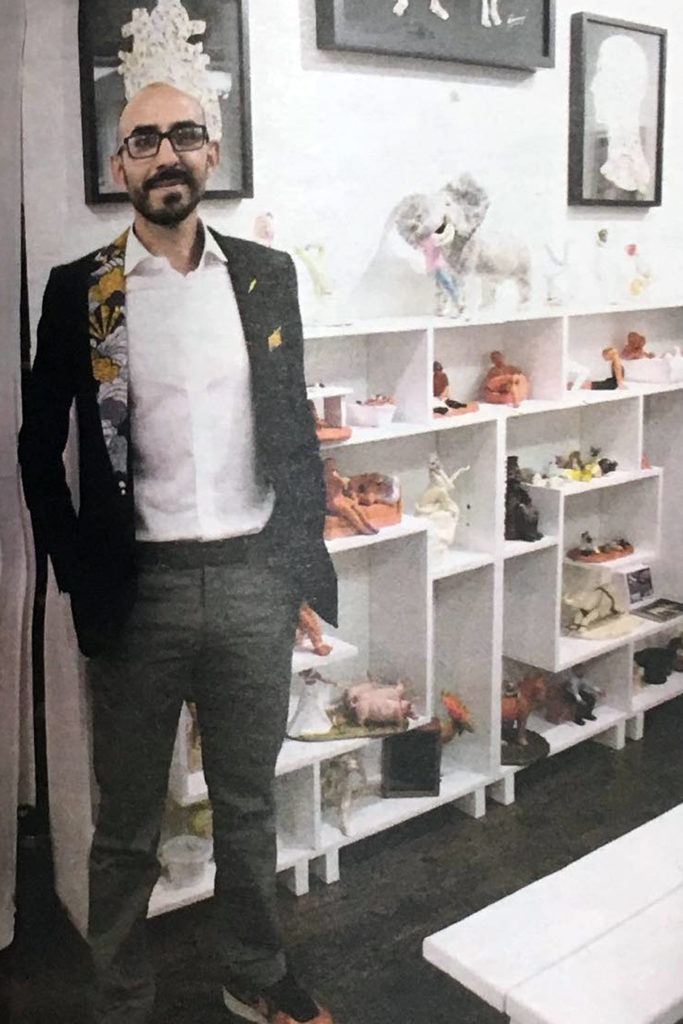
Joanathan Bessaci
Artist Biography
Joanathan Bessaci is a French visual artist based in Washington, D.C., whose practice explores memory, identity, and human connection through the transformation of archival materials. Working across paper, photography, textile, and sculpture, he develops a language where materials act as carriers of personal and collective histories.
Born in Lyon in 1980 into a multicultural family with Vietnamese, Kabyle (Algerian Berber), and French roots, Bessaci’s work is deeply shaped by questions of heritage, displacement, and belonging. His childhood, spent alongside his grandfather in flea markets, fostered an early fascination with found objects, old papers, and forgotten images—elements that continue to inform his artistic vocabulary.
Initially trained in applied arts and photography, Bessaci began his career through painting and graffiti in the late 1990s, developing a strong sensitivity to gesture, composition, and portraiture. His early works explored themes of identity, adolescence, and cultural imagery, influenced by the visual language of the 1980s and artists such as Wassily Kandinsky.
A turning point in his practice emerged through his use of vintage road maps. Far from decorative elements, maps became for him a complex system of memory, geography, and narrative. Carefully selected for their textures, colors, and histories, these materials are cut, layered, fragmented, and reassembled into portraits and compositions that oscillate between abstraction and figuration.
Over time, his technique has evolved from assembling maps between layers of glass to a more open and sculptural approach. Fragments now extend beyond the frame, suspended, torn, or pinned in space, revealing absences and fractures. This shift reflects a broader conceptual move toward instability, rupture, and reconstruction—echoing the fragmented nature of memory and identity.
His work often incorporates materials such as fabric and red thread, which function as visual and symbolic elements of connection, circulation, and time. Through these layered compositions, Bessaci creates works that can be read at multiple distances: from a recognizable image to a dense network of lines, routes, and interruptions.
In parallel, his sculptural practice—particularly through recycled cardboard—extends these ideas into three dimensions. His animal forms, both monumental and intimate, explore transformation, resilience, and the relationship between humans and their environment. Rooted in reuse and collective engagement, these works also reflect his interest in transmission and collaboration, notably through workshops with children.
Bessaci’s work increasingly expands into installation, where space becomes an active component of the narrative. Elements such as linear interventions, floor-based cartographies, and spatial compositions invite viewers to physically navigate the work, shifting their perception and relationship to memory and time.
In 2024, he was selected for the Lucca Biennale of Paper in Italy, where he created a monumental sculpture, marking a significant milestone in his career. This experience reinforced his engagement with large-scale work and installation-based practices.
Through a practice that bridges personal history and shared experience, Joanathan Bessaci develops a body of work that resists fixed interpretation, instead opening spaces for reflection, connection, and dialogue.
The Artist and the Map
Joanathan Bessaci’s work explores memory as a living, unstable structure — something that can be fragmented, altered, and reassembled over time.
Using road maps, archival materials, and found images, he constructs compositions where the body and the territory become inseparable. The map is no longer a tool for orientation, but a language — a dense network of lines that echoes the complexity of human experience, movement, and identity.
In his practice, cutting, tearing, and assembling are not only formal gestures but acts of transformation. Fragments are displaced, layered, sometimes left incomplete, allowing gaps and silences to emerge. These interruptions are essential: they reflect the way memory operates — partial, subjective, and constantly shifting.
Thread, fabric, and paper function as carriers of time. They bring together different histories, textures, and origins, creating connections between what is visible and what has disappeared. The presence of the body — sometimes explicit, sometimes absent — reinforces this tension between permanence and erasure.
Rather than fixing a narrative, Bessaci’s work opens a space where memory can be experienced physically. Through fragmentation, accumulation, and reconstruction, each piece becomes a site of negotiation between past and present, structure and collapse, intimacy and distance.
Residencies / Biennales
- 2024 — Lucca Biennale Cartasia, Italy — Artist in Residence
Awards / Grants
- 2024–2025 — DC Commission on the Arts and Humanities — Art Bank Program
🔥 Exhibitions & Projects (Chronological)
2026
- LOOK Arlington, Arlington Artists Alliance — Site-specific installation
- Art + Arch Exhibition, BELL Architects, Washington, DC
- Fiber Exhibition, Albert Work Studio, New York
- Glen Echo Park — Environmental Justice Exhibition
- Zenith Gallery — 48th Anniversary
2025
- DC Art Bank Exhibition, Washington, DC
- McLean Project for the Arts, VA
- Sandy Spring Museum Sculpture Show, MD
- Kamala Harris Series, Zenith Gallery
2024
- DC Commission on the Arts and Humanities — Art Bank (Finalist + Grant)
- Lucca Biennale Cartasia — Residency + Indoor Exhibition
- Alliance Française Exhibition, Washington, DC
- ADMO Art Walk (solo), Washington, DC
- By The People x Monochrome Art Fair
https://bythepeople.org/
2023
- DC Zesty Story — Studio Visit / Feature
https://www.instagram.com/dczestystory/
2022–2023
- Galerie & Atelier Jamault — Solo Show
https://www.galeriejamault.com/
2021
- Galerie Bessaci — Independent Solo Project
- Brave Spaces – Resilience Project
2020
- Outsider Art Fair
https://www.outsiderartfair.com/new-york - Art on Paper Fair
https://thepaperfair.com/ny - Art Brut Global – Phase II
- Brave Spaces – Resilience Project #2 (publication)
- By The People x Monochrome Art Fair
2018
- Superfine Art Fair, Washington, DC
https://superfine.world/washington-dc/ - Gallery O on H — Solo Show (first US gallery)
https://www.galleryoonh.com/
2017
- Hill Center Galleries
http://www.hillcenterdc.org/galleries
2014
- Rouge Gingembre — Solo Show
- Le Petit Joseph — Solo Show
2013
- Studio Beluga, Montreal
- Mood Festival, Montreal
- Isabelle Poli Galerie — Solo Show
2011
- Sapristi, Villeurbanne
2010
- Studio 55 (Residency at Pierre Cardin) — Exhibition + Catalogue
2009
- Urban Graffiti Art II, Maison Leclerc — Auction Exhibition
2008
- 400ML Project, Maison des Métallos — Publication
2007
- Espace Albert Camus — Solo Show
2006
- Galerie Passerelle — Solo Show
- Ke Pêcherie — Solo Show
- Toast Gallery
- La Platform — Nuits Sonores
2005
- La Belle Équipe — Solo Show
2003
- Bruno Branca — Solo Show
2002–2001
- Galop’Art
- Cadres & Cadres
Practice
- Cartography, memory, and identity
- Portrait and gaze-centered work
- Sculpture and installation
Medium
Mixed Media — Map Collage — Photography — Sculpture
Languages
French, English