
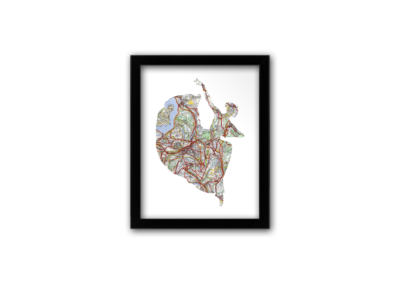
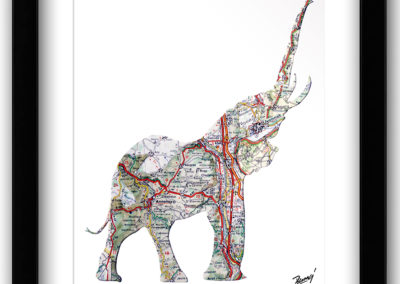
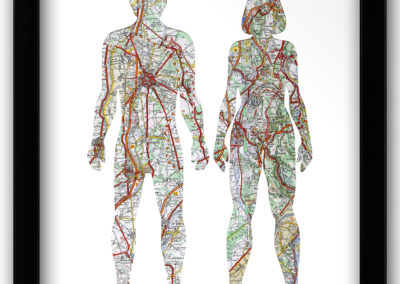
Cutouts
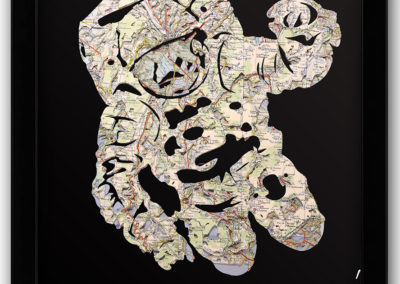
In this series, the map is no longer a tool for orientation, but a material through which I explore memory, choice, and transformation.
I am not interested in following a precise route. What matters is not geographic accuracy, but the presence of the road itself — its density, its network, its ability to suggest trajectories. I select maps for their visual intensity: the concentration of lines, their color, their texture. More recent maps, denser in networks, often structure the foreground, while older ones, more sparse in information, remain in the background, creating both visual and temporal depth.
The map also carries a charged territory. It holds questions of borders, circulation, and belonging. Through it, I found a way to approach more personal experiences related to displacement and identity — things that move through bodies and histories without always being directly expressed. The territory becomes a language.
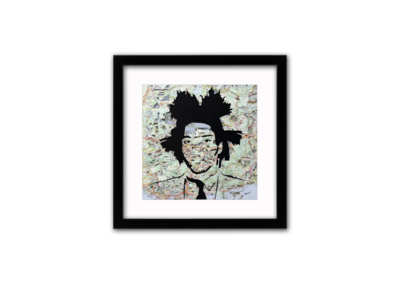
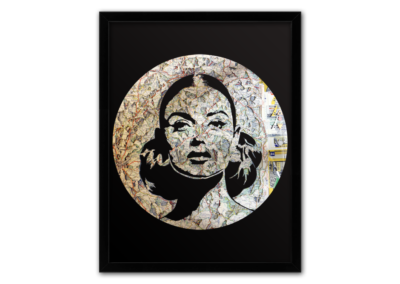
The process begins with an intention, a sketch. The gaze plays a central role. It is through it that I try to bring out a presence, an intensity — as if it were a point of access to something deeper. I construct this area carefully, despite the constraints of the material, which requires connections to remain, preventing complete freedom. At the same time, the material intervenes: certain lines or densities sometimes fall exactly where they need to be, revealing an unexpected force.
The work then develops in a sustained state of concentration, close to meditation. This was not natural to me at first. Coming from graffiti and painting meant movement, space, and physical energy. Here, everything contracts. The gesture becomes slower, more precise, almost silent. What was once a constraint has become an interior space — a form of immersion where time shifts.
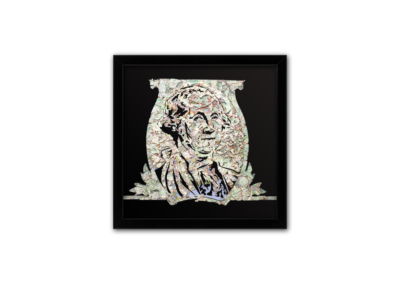
Cutting, removing, preserving — each action is a decision. By removing material, I erase certain information while revealing other structures. The cut often acts as a form of emphasis, exposing tensions already present within the map. Chance occurs in the act of cutting. A line may shift, a form may appear where it was not expected. These displacements are not mistakes; they often feel more accurate than the original intention. They contribute to the language of the work.
The silhouette is never abstract. It imposes an immediate presence. In the portraits, this presence is concentrated in the gaze, which becomes a point of fixation and intensity. Many of these works focus on female figures — not as decorative subjects, but for what they embody: strength, origin, continuity. The body is frontal and recognizable, while its interior remains unstable, crossed by networks, voids, and flows.
The layering of maps creates a physical and perceptual depth. From a distance, the viewer perceives a clear silhouette. As one approaches, the image reveals itself as a construction of maps. And at close range, the superimposed layers open into a dense interior space — almost like entering the work itself. This movement inward is both visual and metaphorical: it suggests a passage into something more organic, where networks resemble veins or internal structures, inviting a deeper exploration.
The time of making is long and dense. Each piece requires several days of work, often dozens of hours of cutting and assembling. This duration produces a deep immersion, accompanied by a real fatigue tied to the intensity of concentration.
The moment when the map becomes an artwork is not immediate. While cutting, nothing is yet fixed — only fragments in progress. It is through assembly, and then framing, that the image stabilizes. The use of glass, sometimes layered, introduces distance and depth. More recently, some works move away from glass, allowing fragments to exist more directly in space. These approaches coexist and reflect an evolution in the practice.
I work with very few tools. A cutter, a blade, and maps. This economy of means refocuses the gesture and demands constant attention.
The moment of stopping comes through intuition. As material disappears, possibilities narrow. It becomes necessary to stop to preserve the balance of the image. Some works remain unresolved, others are revisited, reworked, or abandoned. Failure is also part of the process.
What I seek is not to impose a reading. The work offers a space in which the gaze can move — from afar as an immediate form, and up close as a dense territory of details, ruptures, and continuities.
When I cut a map, I am not trying to represent a place.
I reveal a depth.